How Our Strategy Works
You already know the pieces. MACD measures momentum direction. ADX measures trend strength. Crossovers are the trigger points. ADX filtering separates real signals from noise.
Now let's put it all together. Here's exactly how the system works — no hand-waving, no mystery.
The Setup
Indicator: MACD with parameters 12, 26, 9. That's a 12-day fast moving average, a 26-day slow moving average, and a 9-day signal line. Standard settings. We tested alternatives and these performed best over five years.
Trend filter: ADX with a 14-day period. This smooths 14 days of directional movement data into a single trend strength number.
Timeframe: Daily candles for most assets. One reading per day, based on the closing price. We tested 4-hour candles across five years for BTC — they produced about 67 signals per year (versus 18 for daily) with worse results. Too many signals, too much noise. A few assets (HYPE, ATOM) are exceptions where daily is unusable and 4h is the only profitable timeframe.
Mode: Long-only. We never short. More on why below.
The Rules
The entire strategy boils down to two rules:
Rule 1 — Exit (bearish crossover): When the MACD line crosses below the signal line, we exit the position and go to cash. This fires every time. No exceptions, no ADX check, no "let's wait and see." If momentum is pointing down, we're out.
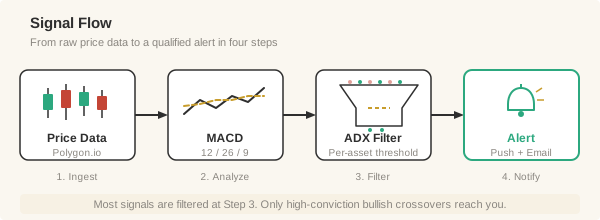
Rule 2 — Entry (bullish crossover + ADX gate): When the MACD line crosses above the signal line, we check ADX. If ADX is above the asset's threshold, we re-enter. If ADX is below the threshold, we stay in cash and wait for a stronger setup.
That's it. Two rules. One indicator pair.
The asymmetry is intentional. Exits are aggressive because the cost of holding through a crash is enormous — BTC dropped 56.8% in Q2 2022. Entries are conservative because the cost of missing the first few days of a rally is small compared to entering during a false signal.
Per-Asset ADX Thresholds
Not every crypto asset trends the same way. We set a different ADX threshold for each based on five years of quarterly backtesting:
| Asset | ADX Threshold | Why This Number |
|---|---|---|
| BTC | >20 (1D) | Standard confirmation. Moderate threshold catches most real trends. |
| ETH | >25 (1D) | ETH trends hard and persistently — needs stronger confirmation to filter midrange noise. |
| ADA | >20 (1D) | ADA's trends establish fast. ADX>20 catches them early. Waiting longer means entering late. |
| LINK | >20 (1D) | Standard works. Similar trend characteristics to BTC. |
| SOL | >20 (1D) | Bearish signal detection — catches 89% of >10% crashes on 4h. |
| XRP | >20 (1D) | Second-highest mean alpha (+5.8%/quarter). Standard threshold. |
| TRX | >40 (1D) | Highest threshold in the system. Only fires ~6 times/year, but when it does, profit factor is 3.79. |
| DOGE | >25 (1D) | Meme-driven spikes distort the data. ADX>25 filters the worst false starts. |
| HYPE | >35 (4h) | Daily timeframe is unusable — 4h is the only profitable config. Provisional (7 months of data). |
| ATOM | >40 (4h) | Like HYPE, daily doesn't work. 4h ADX>40 beats hold in 81% of quarters. |
| ONDO | None (1D) | Plain MACD, no ADX gate — ADX filtering actually hurts this asset. Provisional (23 months of data). |
These thresholds come from testing multiple parameterizations (ADX>15, >20, >25, >30, >35, >40, and plain MACD with no filter) across up to 22 quarters per asset. ETH's preference for ADX>25 was the most surprising finding — it costs about 5 percentage points per quarter to use ADX>20 on ETH instead.
Why Long-Only
We tested long-only against long-plus-short over five years. Long-only wins, and it's not close.
| Mode | Mean Quarterly Alpha | Worst Quarter |
|---|---|---|
| Long-Only | -1.89% | -38.86% |
| Long+Short | -2.62% | -75.28% |
Shorting BTC in a predominantly bull market creates catastrophic losses when signals misfire. One bad short during a strong rally can wipe out a year of gains. Long-only cuts the worst-case drawdown nearly in half. The trade-off — missing some profit during confirmed downtrends — is worth the stability.
When we exit on a bearish crossover, we go to cash. We earn 0% while we wait. That's okay. Cash is a position.
Time in Market
On average, this strategy has you invested about 51% of the time. The other 49%, you're sitting in cash waiting for the next qualified bullish signal.
That sounds like a lot of time on the sidelines. And it is. But consider what you're avoiding during that time. In Q2 2022, being in cash while BTC dropped from $47K to $20K was the difference between a -56.8% loss and a +34.77% alpha advantage.
The system doesn't try to be in the market every day. It tries to be in the market during the right days.
What Happens at Each Step
Here's a typical cycle:
- You're holding BTC. MACD is positive, ADX is at 28. Everything's fine.
- MACD histogram starts shrinking. Momentum is slowing.
- The MACD line crosses below the signal line. Bearish crossover fires. You exit to cash.
- BTC drops 15% over the next two weeks. You're in cash. Watching.
- BTC stabilizes. MACD line starts climbing back toward the signal line.
- MACD crosses above the signal line. Bullish crossover. The system checks ADX.
- ADX is at 16 — below the 20 threshold. Signal suppressed. You stay in cash.
- A few days later, the trend strengthens. ADX climbs to 22.
- Another bullish crossover fires. ADX is above 20. Signal qualifies. You re-enter.
Steps 7 and 8 are where ADX earns its keep. Without the filter, you'd have re-entered at step 6 — during a weak, unconvincing bounce that might have reversed. The ADX gate makes you wait for conviction.
The Honest Limitations
For BTC, the mean quarterly alpha is -1.89% — most quarters, the strategy slightly underperforms buy-and-hold. The five-year total doesn't come out ahead either: under realistic next-morning fills, the strategy finishes behind just holding. (We used to publish a positive total here; it came from a backtest that filled trades at prices you can't actually get, and we retracted it.) ETH looks similar: slightly negative per-quarter average, beats hold in 55% of quarters. What the strategy reliably delivers on both is early bearish detection — Q2 2022's exit alone was worth +34.77% alpha on BTC — which makes it an exit discipline, not an outperformance engine.
It doesn't predict price targets. A bearish crossover tells you momentum is down. It doesn't tell you whether BTC will drop 5% or 50%.
It doesn't work on short timeframes for most assets. We tested 4-hour on BTC and it was unprofitable over five years. The exceptions — HYPE and ATOM — use 4h because their daily timeframe is even worse.
And it can fail across all assets simultaneously. Q4 2023: BTC, ETH, ADA, and LINK all had significant bull runs, and all four strategies underperformed buy-and-hold that quarter. Diversification didn't help.
We cover the full performance picture — including the assets where this strategy does generate positive alpha — in Honest About Our Performance.
Two rules, two indicators. Exit when momentum breaks. Enter when momentum and trend strength agree. Stay in cash when they don't.
This is educational content, not financial advice. Past performance does not guarantee future results.