MACD Crossovers Explained
Every signal our app sends you starts with a crossover. But not every crossover deserves your attention — and that distinction is worth understanding.
If you've read What Is MACD?, you know there are two lines: the MACD line (fast momentum) and the signal line (smoothed momentum). A crossover happens when these two lines swap positions. One minute MACD is above the signal line, the next it's below — or vice versa.
That swap is the moment we care about. Something just changed.
Bullish Crossover: Momentum Shifting Up
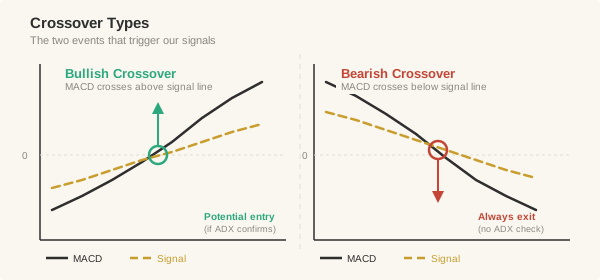
A bullish crossover happens when the MACD line crosses above the signal line. In plain terms: short-term momentum just overtook the longer-term trend. The asset is accelerating.
In our system, a bullish crossover on daily candles indicates momentum has shifted upward. Our strategy treats this as a potential re-entry point — the system moves from cash back into the asset.
"Potential" is doing a lot of work in that sentence. Not every bullish crossover leads to real gains — which is why we filter them.
Bearish Crossover: Momentum Fading
A bearish crossover is the opposite — the MACD line drops below the signal line. Momentum is decelerating. The car's speedometer is falling from 70 back toward 55 and below.
For us, this is an exit signal. Every time. We don't wait for confirmation, we don't second-guess it, we don't hope it reverses. The bearish crossover fires, we exit to cash. No exceptions.
Why so aggressive on exits? Because the cost of being wrong on an exit is small — you miss some upside. The cost of being wrong on a hold during a crash is enormous. In Q2 2022, BTC dropped 56.8%. Holding through that hurts a lot more than exiting early during a false alarm.
The False Signal Problem
Here's where crossovers get tricky. Not all of them mean something real.
During choppy, sideways markets — when an asset isn't really trending in either direction — the MACD line and signal line dance around each other. They cross, uncross, cross again. Every crossing looks like a signal, but none of them lead anywhere meaningful. You'd get whipsawed: buying, selling, buying, selling. Each round trip costs you a little.
Over five years of backtesting across nine assets, we saw this pattern repeatedly. The crossovers during strong trends were valuable. The crossovers during sideways chop were noise.
So how do you tell the difference?
Enter the Referee
Think of a basketball game. A player drives to the basket, there's contact, the ball goes in. Does the basket count? That depends on the referee's call.
ADX is our referee. It measures trend strength — how strongly the asset is actually moving in one direction. When ADX is high, the trend is real, and the crossover "counts." When ADX is low, the market is just wandering sideways, and the crossover is noise.
We don't act on bullish crossovers unless ADX says the trend is strong enough. Bearish crossovers always count — because missing a crash is worse than exiting during a weak trend.
This is the core of our filtering system, and it makes a measurable difference. Without ADX filtering, our backtesting shows significantly more false bullish signals. With it, we skip the noise and only act when the trend has conviction behind it.
We cover ADX in depth in What Is ADX?. But here's the headline: crossovers are the raw signal, ADX is the quality filter. You need both.
Crossovers in Practice
On a daily chart, BTC generates roughly 18 crossover signals per year — about one every three weeks. Not all of them pass the ADX filter. The ones that do have meaningfully better outcomes in our backtesting.
ADA generates about 14 signals per year. ETH about 11. The frequency varies by asset because each asset has different volatility patterns and trend characteristics.
Most assets run on daily candles. We tested 4-hour candles for BTC and got about 67 signals per year — too many, too noisy for most assets. A few exceptions (HYPE, ATOM) actually perform better on 4-hour timeframes, so we use what the data supports per asset. Signal quality matters more than signal quantity.
A crossover tells you momentum just changed direction. Whether that change matters depends on whether the trend behind it is real — and that's what ADX is for.
This is educational content, not financial advice. Past performance does not guarantee future results.