What Is MACD?
Your car's speedometer doesn't tell you where you're going. It tells you how fast you're getting there. MACD does the same thing for crypto prices — it measures momentum, not price targets.
If you've ever watched BTC swing from $60K to $30K and wondered when the slide actually started, MACD would have shown you. Not because it predicts the future. Because it tracks whether price momentum is speeding up or slowing down, in real time.
The Three Pieces
MACD stands for Moving Average Convergence Divergence. That's a mouthful. Here's what it actually means in plain terms.
But first — a moving average is just the average price over a rolling window of time. A 12-day moving average takes the last 12 days of closing prices and averages them. Each new day, the window slides forward: the oldest day drops off, the newest day gets added. The result is a smooth line that filters out daily noise and shows you the general direction price has been heading.
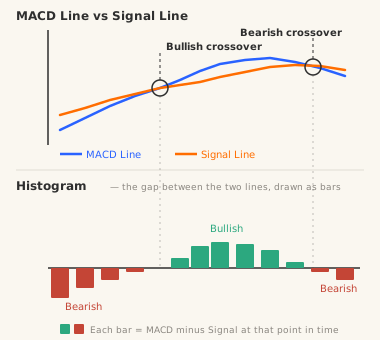
The MACD line. Take two moving averages of an asset's price — one fast (12-day) and one slow (26-day). Subtract the slow one from the fast one. That's your MACD line. When the fast average is above the slow one, MACD is positive — momentum is pushing upward. When it's below, momentum is fading.
The signal line. This is a 9-day moving average of the MACD line itself. Think of it as a smoothed version — it filters out the day-to-day noise so you can see the bigger trend in momentum.
MACD = EMA₁₂(price) − EMA₂₆(price)
Signal = EMA₉(MACD)
The histogram. This is just the gap between the MACD line and the signal line, drawn as bars. Big bars mean momentum is strong. Shrinking bars mean momentum is weakening. When the bars flip from positive to negative (or vice versa), that's a crossover — and that's where things get interesting.
Why Traders Watch It
Most people stare at the price line and try to guess where it's going next. That's hard — and most guesses are wrong.
MACD offers something different. Instead of asking "where is the price going?" it answers "is the rate of price change increasing or decreasing?" That's a more useful question. When the rate of change slows down, a reversal often follows. Not always. But often enough to matter.
Here's a concrete example. In early 2022, BTC was trading around $45K. The price hadn't crashed yet — it was just drifting sideways. But MACD was already telling a different story. The MACD line was falling below the signal line. Momentum was dying before the price reflected it. By the time BTC hit $20K that summer, the MACD had been negative for weeks.
That's the speedometer doing its job. You didn't need to predict $20K. You just needed to see that momentum was pointing down.
What We Use
We use MACD with specific settings: 12, 26, and 9. That means the fast average is 12 days, the slow average is 26 days, and the signal line smooths over 9 days. These are standard settings — nothing exotic.
We tested multiple timeframes — from hourly candles up to weekly. For most assets, daily produces the cleanest, most meaningful signals. Shorter timeframes generate too much noise; longer ones react too slowly. A few assets (like HYPE) work better on 4-hour candles — it depends on how each asset trends.
But here's the honest part: MACD alone isn't enough. It catches real shifts in momentum, but it also fires during choppy, sideways markets where there's no real trend. Those false signals can hurt you. That's why we pair it with another indicator called ADX — which we cover in What Is ADX?.
What MACD Can't Do
It can't predict price targets. "BTC momentum is slowing" doesn't tell you whether BTC will drop to $50K or $30K.
It can't see sudden events. A tweet, a hack, a regulatory announcement — MACD is a lagging indicator. It reacts to what's already happened in price, not what's about to happen.
And it doesn't work well on very short timeframes for crypto. Day trading with MACD on 15-minute charts? Our data says no.
MACD is a speedometer for momentum — it tells you when something is changing speed, not where it's going. Pair it with a confidence filter, and you've got something useful.
This is educational content, not financial advice. Past performance does not guarantee future results.