What Is ADX?
MACD tells you which way momentum is shifting. But it doesn't tell you whether that shift matters. ADX does. It measures how strongly an asset is trending — not the direction, just the conviction behind the move.
ADX stands for Average Directional Index. It outputs a single number, typically between 0 and 50+, that answers one question: how strongly is this asset trending right now?
Not which way. Just how strongly.
Reading the Number
ADX is straightforward once you know what the ranges mean.
Below 20: Weak trend or no trend. The asset is drifting sideways, chopping around without conviction. Signals generated during this zone are unreliable — there's no real momentum behind them.
20 to 30: The trend is establishing. Things are starting to move in one direction with some conviction. For most of our assets, this is where signals start to become meaningful.
Above 30: Strong trend. The asset is moving decisively. Crossover signals fired during this zone tend to be more reliable because there's real directional energy behind them.
Above 40: Very strong trend. These are the big moves — the kind that show up in headlines. Q2 2022's crypto crash, for instance, had ADX readings well above 30 across multiple assets.
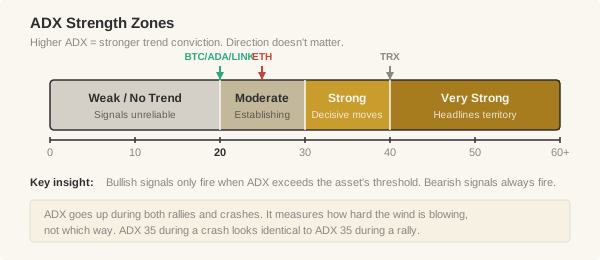
One thing that trips people up: ADX goes up during both rallies and crashes. A strong downtrend pushes ADX just as high as a strong uptrend. Remember — it's measuring trend strength, not direction. It doesn't care which way the wind is blowing, only how hard it's blowing.
How We Use It
Remember the speedometer analogy from What Is MACD?? MACD tells you when momentum is shifting. But MACD can fire during choppy, sideways markets where there's no real trend. Those false signals cost you money.
ADX is the filter. When MACD says "momentum is shifting up" and ADX says "yes, and the trend behind it is strong," we act. When MACD says "momentum is shifting up" but ADX says "there's barely any trend here," we wait.
Specifically: we check whether ADX is above a threshold before we trust a bullish crossover. If ADX is below that threshold, we suppress the signal. It doesn't fire. We stay in cash and wait for a more convincing setup.
For bearish crossovers — the exit signals — we don't apply an ADX filter at all. If momentum is pointing down, we get out regardless of trend strength. Missing a crash is worse than exiting early during a weak downtrend.
Calculating ADX
ADX is derived from something called the Directional Movement system. Without going deep into the math: it looks at each candle's price range and figures out whether the bulls or the bears had more control. It then smooths those readings over 14 periods (that's the period we use) to produce the ADX value.
DI+ = (+DM / ATR) × 100
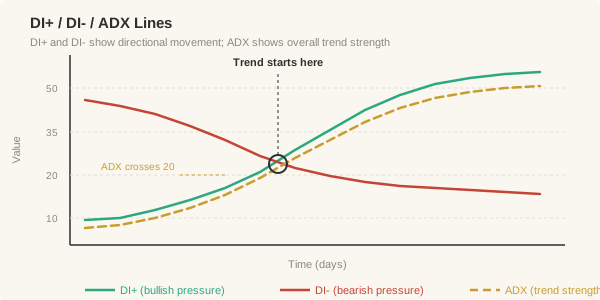
You don't need to calculate it yourself. The app calculates it automatically on every candle — daily for most assets, 4-hour for some. But knowing it's based on 14 periods of data helps explain why it reacts slower than MACD — it's measuring a longer-term pattern of directional conviction.
What ADX Can't Do
ADX can't tell you which direction the trend is going. An ADX of 35 during a rally looks identical to an ADX of 35 during a crash. You still need MACD (or another directional indicator) for that.
It also can't predict when a trend will start. ADX is reactive — it tells you a trend is happening after it's underway. By the time ADX climbs above 20, the move has already started. That's okay for our purposes. We're not trying to catch the exact bottom. We're trying to filter out noise.
ADX is a confidence meter for trends — it tells you whether to trust the signal MACD just gave you.
This is educational content, not financial advice. Past performance does not guarantee future results.