Why ADX Matters for Our Signals
Here's a number that changed our entire strategy: across five years of BTC backtesting, switching from plain MACD to MACD with ADX filtering cut out the weakest signals — the ones that fired during choppy, directionless markets and led nowhere. Without ADX, every MACD crossover looks equally important. With it, you can tell the real moves from the fakes.
We covered crossovers in MACD Crossovers Explained — now let's see why some of them lie.
The Problem with Unfiltered Signals
Plain MACD on daily candles generates roughly 18 signals per year for BTC. Some of those signals fire during strong trends — like the weeks before the Q2 2022 crash, when BTC was clearly breaking down. Those signals are gold. They get you out before the worst of it.
But other signals fire during sideways chop. BTC bounces between $58K and $62K for three weeks. The MACD line and signal line dance around each other. Cross up. Cross down. Cross up again. Each one technically qualifies as a signal. None of them mean anything.
Those are the signals that cost you. You exit, the price drifts up. You re-enter, the price drifts down. You exit again. Each round trip chips away at your returns. Over 20 quarters, those false signals add up.
The Filter Steps In
Remember the confidence meter from What Is ADX?? ADX decides which signals count.
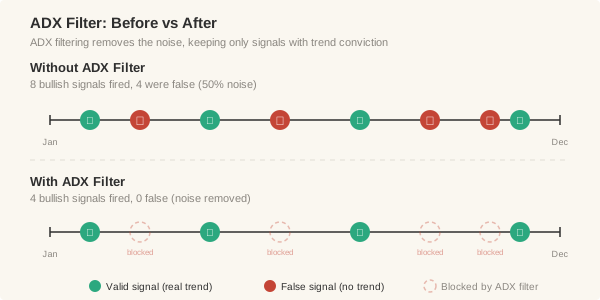
When we add an ADX threshold to our bullish entry signals, we're telling the system: "Don't re-enter the market unless the trend has real conviction behind it." A MACD bullish crossover fires, and the system checks ADX. If ADX is below the threshold — below 20 for BTC, below 25 for ETH — the signal doesn't count. We stay in cash. We wait.
This filter only applies to bullish crossovers. Bearish signals — the exit signals — always fire regardless of ADX. We don't want to second-guess an exit. If momentum says "get out," we get out. The asymmetry is deliberate: the cost of a false exit is small (you miss some upside), but the cost of ignoring a real exit signal is potentially catastrophic.
What the Data Shows
We ran five years of backtesting across six assets: BTC, ETH, ADA, LINK, SOL, and DOGE. For each asset, we compared plain MACD against MACD with ADX thresholds at 15, 20, 25, and 30.
Here's what we found for BTC:
| Strategy | 5yr Alpha (same-close fills) | Profit Factor | Signals |
|---|---|---|---|
| Plain MACD | +26.08% | 1.13 | 138 |
| MACD + ADX>20 | +46.32% | 1.21 | 92 |
One honesty note before you read the alpha column: both rows come from a backtest that filled trades at the same candle's close — a price live trading can't get, since the crossover is only known after the close. A later re-run with realistic next-morning fills pushed BTC's five-year alpha below zero for every configuration. So treat these numbers as a comparison between configurations, not a live-trading expectation. The comparison is the point, and it survives the methodology fix: the ADX gate improves the profit factor and drops 46 of 138 raw crossovers — the low-conviction signals that fire during choppy, directionless markets. Fewer trades, better trades.
The Filter in Production
Backtests tell you what should happen. Production tells you what actually happened. Over five years of live BTC signals on daily candles, we detected 72 bullish MACD crossovers. The ADX filter suppressed 18 of them — exactly 25%.
Here's the game tape. Those 18 blocked signals cluster where you'd expect — choppy, directionless markets:
- Bear market chop (late 2022 – early 2023): Five suppressed signals between $16,669 and $23,815. BTC was grinding sideways at the bottom. MACD kept crossing — ADX said none of it was real.
- Pre-election consolidation (mid-2024): Three suppressed signals around $66,000–$71,000. BTC was range-bound for weeks. The crossovers looked like something. They weren't.
- Extended 2025 consolidation: Six suppressed signals between $83,380 and $119,309. BTC was above $100K but directionless. ADX stayed below 20 for weeks at a stretch.
On the other side of the threshold, three bullish signals barely made it through — ADX at 20.13, 20.39, and 20.41. The boundary is tight. One of those fired on January 29, 2024, with BTC at $43,269 and ADX at 20.13. A margin of 0.13.
Bearish signals? All 51 fired. Zero filtering. We don't second-guess exit signals — that asymmetry is deliberate and the production data confirms it works as designed.
One Size Doesn't Fit All
Here's the finding that surprised us most. When we tested ETH, ADX>20 didn't work well. The best threshold for ETH was ADX>25 — meaningfully higher than BTC's ADX>20.
Why? ETH trends hard and persistently. When it starts moving in one direction, the momentum builds gradually but powerfully. Using ADX>20 lets in too much of ETH's choppy midrange noise — those medium-strength trends that look like they're going somewhere but fizzle out. ADX>25 waits for stronger confirmation. The difference in mean quarterly alpha: -0.54% (ADX>25) versus -5.90% (ADX>20). That's more than 5 percentage points per quarter, just from adjusting one threshold.
ADA tells a different story. In the original sweep, every ADA configuration came out positive — plain MACD and every ADX gate we tried. We've since gone further with ADA: production now runs a deferred-confirmation rule at ADX>30, which holds a suppressed bullish cross pending and takes the entry when ADX catches up. That change lifted ADA's mean quarterly alpha to +8.3% — the strongest daily-timeframe result we have. The details are in Why Each Asset Gets Its Own ADX Threshold.
You can't use the same filter everywhere. The data is clear on this.
When ADX Filtering Can't Help
ADX filtering improves signal quality, but it doesn't fix fundamental problems. For DOGE, no ADX threshold makes a meaningful difference because DOGE's biggest price moves aren't trend-driven — they're driven by social media events that no technical indicator can anticipate.
And ADX filtering can't prevent systematic misfires. In Q4 2023, all four of our tracked assets had significant bull runs. All four strategies were poorly positioned. ADX was high — the trends were real — but the MACD timing was off at the start of the move. BTC: -29.83% alpha. ADA: -34.64%. LINK: -63.93%. Diversifying across assets didn't help because the failure was systematic, not asset-specific.
We always disclose this. ADX makes our signals better. It doesn't make them perfect.
The Bottom Line
Without ADX filtering, you'd get every MACD crossover — the strong ones and the noise. With it, bullish entries only fire when the trend has real conviction. Bearish exits always fire, because caution on the way out is more important than precision on the way in.
The specific thresholds matter: BTC uses ADX>20, ETH uses ADX>25, TRX uses ADX>40, and every other asset has its own optimized gate. These aren't arbitrary numbers — they come from five years of quarterly backtesting. Each asset's trend characteristics are different, and the threshold has to match.
ADX is the filter that decides which MACD signals count — and five years of data show it catches more noise than it misses real moves.
This is educational content, not financial advice. Past performance does not guarantee future results.