Why Each Asset Gets Its Own ADX Threshold
We expected one ADX threshold to work everywhere. BTC, ETH, ADA, LINK — same indicator, same MACD parameters, same daily candles. Why wouldn't the same ADX filter apply?
Because each asset trends differently. Five years of data made that obvious.
The Thresholds
| Asset | ADX Threshold | Mean Quarterly Alpha | Beat-Hold % |
|---|---|---|---|
| BTC | >20 | -1.89% | 50% |
| ETH | >25 | -0.54% | 55% |
| ADA | >30 (deferred confirmation) | +8.3% | 75% |
| LINK | >20 | +0.70% | 55% |
| SOL | >20 | -7.1% | 50% |
| XRP | >20 | +5.8% | 64% |
| DOGE | >25 | -16.2% | 59% |
| TRX | >40 | -0.46% | 45% |
| ATOM | >40 (4h) | +9.4% | 81% |
| HYPE | >35 (4h) | +4.30% | n/a* |
| ONDO | None (plain MACD) | +3.6% | 57%** |
| AVAX | None (plain MACD) | +31.17% | 100% |
*HYPE has only 7 months of data — too short to calculate a reliable beat-hold percentage. **ONDO has 23 months of data — provisional configuration.
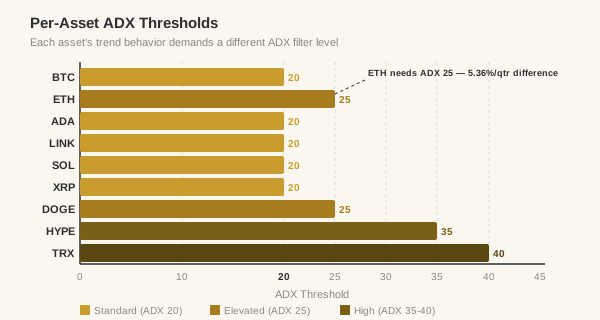
Four assets at ADX>20. Two at ADX>25, ADA at ADX>30 with a deferred-confirmation rule, two at ADX>40, HYPE at ADX>35, and two assets (ONDO and AVAX) with no ADX filter at all. Two assets break the daily-only rule — ATOM and HYPE use 4h candles. Each outlier is where the story gets interesting.
Fire bullish only when ADX > threshold for that asset
ETH: Why Higher Is Better
When we first ran ETH through the same ADX>20 threshold as BTC, the results were noticeably worse: -5.90% mean quarterly alpha. Switch to ADX>25, and it improves to -0.54%. That's more than 5 percentage points per quarter, just from adjusting one number.
Why? ETH trends hard and persistently. When ETH starts moving in a direction, it commits. The momentum builds gradually, ADX climbs steadily, and the trend plays out over weeks. That's great for MACD — the crossover signals are meaningful.
But ETH also has a noisy middle zone. It'll spend days with ADX between 15 and 23, moving enough to trigger MACD crossovers but not enough for those crossovers to lead anywhere. Using ADX>20 lets too many of these midrange signals through. ADX>25 waits for the trend to actually establish before acting.
Think of it this way: ETH doesn't dip its toe in — it cannonballs. But there's a lot of splashing around before the cannonball. ADX>25 ignores the splashing and only reacts to the real jump.
BTC, LINK, XRP: Standard Threshold Works
For these three assets, ADX>20 is the sweet spot. Their trends establish at moderate conviction levels, and waiting for ADX>25 or higher means entering too late and missing part of the move.
How often does the filter actually activate? For BTC, ADX sits below 20 on 24% of daily candles — roughly one day in four. That's enough to catch the choppy consolidation periods (bear market bottoms, range-bound months above $100K) while letting the majority of trending days through. In production, the filter suppressed 18 out of 72 bullish crossovers over five years — a 25% suppression rate that matches the ADX distribution almost exactly.
XRP is a clear example of the boundary being structural. At ADX>20, profit factor peaks at 2.25 with +5.8% mean quarterly alpha. Push to ADX>25 and total alpha collapses from +212% to -92% — the filter starts blocking the entries that drive XRP's big winning quarters. The ADX>20 boundary appears structural for XRP, just as it is for BTC and ADA. For the full breakdown, see XRP: What Our Signals Do.
ADA: A Higher Gate, But a Different Rule
ADA started in the ADX>20 group. It doesn't live there anymore, and the reason is a rule change, not just a threshold change.
Our original gate samples ADX at the exact candle where MACD crosses — if the trend hasn't gathered strength yet, the signal is dropped forever. ADA's real moves often start before ADX confirms them, so that rule kept throwing away legitimate entries. The refined rule holds a suppressed bullish cross pending and takes the entry later, whenever ADX clears the bar while MACD is still above the signal line.
Under deferred confirmation, ADA can afford a stricter gate: ADX>30. The combination delivers +8.3% mean quarterly alpha and beats buy-and-hold in 75% of quarters — up from +1.7% mean alpha under the old gate-at-cross rule at ADX>20 (realistic fills). Same edge, less waste. The full story is in Cardano: What Our Signals Do.
SOL: Same Threshold, Different Job
SOL uses ADX>20 — the same threshold as BTC, ADA, and LINK. But the purpose is fundamentally different. For ADA, ADX>20 captures trend-following alpha. For SOL, it's bearish signal detection — flagging when the trend breaks.
SOL's mean quarterly alpha is -7.1%. In a typical quarter, the strategy underperforms buy-and-hold because SOL's rallies are so violent that signal timing can't keep up. But the total alpha over 22 quarters is +163.7%, driven by a few quarters where exit signals fired early during major crashes — Q3 2021 (+129.6% alpha), Q2 2022 (+38.2%), Q4 2022 (+37.4%).
Why not raise the threshold? At ADX>25, SOL's total alpha collapses to -360%. SOL's moves are so fast that by the time ADX climbs above 25, the trend is already halfway over. Fewer signals means missing the critical exit points during crashes — exactly the moments when the strategy earns its keep. ADX>20 generates roughly 21 signals per year, enough to catch the major reversals without waiting for confirmation that arrives too late. For the full SOL story, see Solana: What Our Signals Do.
DOGE: Where Higher ADX Breaks Down
DOGE joins ETH as the second asset using ADX>25. But the reason is different — and, after a methodology correction, more modest.
ETH needs ADX>25 because it has a noisy middle zone — too many false crossovers between ADX 20 and 25. DOGE needs ADX>25 because plain MACD generates 25.9 signals per year — just over our noise threshold. ADX>25 trims that to 15.5 signals per year, cutting trade count by 41% (39 trades vs 66 over five years) at a similar profit factor (1.42 vs 1.50). That's the gate's real job on DOGE: noise reduction, not alpha. When we re-ran DOGE with compound returns and realistic next-open fills, no ADX configuration beat buy-and-hold — the mean quarterly alpha at ADX>25 is -16.2%.
The more interesting finding is what happens when you go higher. At ADX>35, DOGE's profit factor collapses from 1.42 to 0.12. That's not a gradual decline — it's catastrophic. The reason is uniquely DOGE: its biggest moves are meme-driven spikes that push ADX above 35 at the peak. By the time the ADX gate opens at 35, you're buying the top of an already-extended vertical move. The strategy then rides the reversal all the way down.
For most assets, higher ADX means more confidence in the trend. For DOGE, ADX above 35 means the meme spike already happened. ADX>25 is the best of the gated configurations — selective enough to filter noise, without only entering at tops. For the full story, including the correction that removed DOGE's apparent edge, see Dogecoin: What Our Signals Do.
TRX: The Highest Gate in the System
TRX uses ADX>40 — the most selective threshold of any asset we track. And the jump is dramatic: at ADX>35, profit factor is 1.76. At ADX>40, it's 3.79. That's not a gradual improvement — it's a phase change.
Why? TRX is a slow grinder. It gained +566% over five years, mostly through steady appreciation with very few sharp crashes (zero >10% weekly drawdowns in 5 years). Most MACD crossovers on TRX are noise — the asset is just oscillating within a broader uptrend. But when ADX climbs above 40, TRX is in a genuine, committed trend move. Those moves are worth trading.
The cost is silence. At 6.1 signals per year, the strategy sits out most quarters entirely. Eleven of twenty-two tested quarters had zero signals — TRX grinding higher while the strategy held cash. That's why the mean quarterly alpha is -0.46%: essentially flat, because the strategy doesn't participate in most of the upside.
Lower thresholds don't help. ADX>20 through ADX>35 all produce profit factors between 1.34 and 1.76 — positive but unremarkable. The signals aren't bad, they're just not selective enough to overcome the opportunity cost of being out of a +566% asset. ADX>40 is the only threshold where the signal quality justifies the missed gains. For the full story, see TRON: What Our Signals Do.
ATOM: Same Gate, Different Timeframe
ATOM also uses ADX>40 — the same threshold as TRX. But on 4h candles, not daily.
Why the switch? On daily candles, no ADX threshold produces a profit factor above 1.0 for ATOM. Even plain MACD (no filter) only manages PF 0.78 on daily — and adding any ADX gate makes it worse. The daily timeframe simply doesn't work for ATOM, similar to HYPE.
On 4h candles, two thresholds qualify: ADX>20 (PF 1.07, 110 signals/year) and ADX>40 (PF 1.02, 23 signals/year). We went with ADX>40 despite the lower PF. At 110 signals per year, ADX>20 would produce roughly two signals per week — far noisier than any other asset we track. ADX>40 brings that down to about two per month, consistent with the rest of the system.
The quality metrics make the case: 50.9% win rate (highest of any qualifying ATOM config), -79.7% max drawdown (vs -130.7% at ADX>20), and an 81% beat-hold rate across 21 quarters — the highest in the entire system.
Context matters, though. ATOM lost -90% over five years. That 81% beat-hold rate mostly reflects the strategy sitting in cash while ATOM declined, not brilliant signal timing. The +9.4% mean quarterly alpha is real, but it's the alpha of avoiding a sinking ship. For the full ATOM story, see Cosmos: What Our Signals Do.
HYPE: Breaking the Daily-Only Rule
HYPE (Hyperliquid) is the newest addition and the biggest exception. It doesn't just use a different threshold — it uses a different timeframe entirely.
On daily candles, no ADX threshold produces a profit factor above 1.0. Plain MACD, ADX>15, ADX>20, ADX>25 — they all lose money. HYPE went through a brutal 60% drawdown from October 2025 through January 2026, and daily MACD was too slow to adapt. Every bullish crossover was a bear market bounce that reversed.
Switch to 4h candles with ADX>35, and the picture changes: profit factor of 5.57, 75% win rate, +41% alpha versus buy-and-hold. The high ADX threshold means the signal only fires when HYPE is trending hard — and when HYPE trends hard, it really moves.
The caveat is real: this is based on 7 months of data and 4 closed trades. We're transparent about that. Treat it as a working hypothesis, not a proven strategy. We'll re-run the analysis when we have 14+ months of data. For the full HYPE story, see Hyperliquid: What Our Signals Do.
ONDO: When No Filter Is the Best Filter
ONDO is the only asset in the system with no ADX filter at all. Every bullish crossover fires, regardless of ADX level.
This wasn't the plan. We ran the standard ADX sweep — thresholds from 15 through 40 — expecting to find a sweet spot somewhere in the range. Instead, every threshold above plain MACD made things worse. At ADX>20, profit factor drops from 1.11 to 0.54. At ADX>25, it's 0.45. The filter doesn't just underperform — it actively destroys the signal.
Why? Two likely factors. First, ONDO's data history is short (23 months versus 5 years for BTC). The ADX warmup period — 28 candles before the indicator stabilizes — chews through a larger fraction of the dataset. Early trend entries get filtered out before ADX has time to confirm them. Second, ONDO moves fast. It averages 28 signals per year, significantly more than BTC (~18) or ETH (~11). By the time ADX catches up to confirm a trend, ONDO has often already reversed.
The result: plain MACD on daily candles. Profit factor 1.11, +3.6% mean quarterly alpha, +90.8% total alpha over 23 months. Not spectacular, but honestly positive — and adding any filter makes it negative.
This is a provisional configuration. Twenty-three months covers roughly 1.5 market phases. We'll re-evaluate when ONDO has 3+ years of data (approximately late 2027). If the pattern holds across a full cycle, we'll confirm it. If ADX starts adding value with more history, we'll add the filter. For now, the data says keep it simple. For the full story, see Ondo Finance: What Our Signals Do.
AVAX: Same Pattern, Longer History
AVAX is the second asset in the system that runs without an ADX filter. The dynamic is the same as ONDO — any ADX threshold monotonically degrades performance — but with 4.5 years of data instead of 23 months, the conclusion stands on much firmer ground.
AVAX's profit factor runs 1.62 at plain MACD, 1.48 at ADX>20, and collapses below 1.0 at ADX>25. Every threshold we tested made things worse. The reason is that AVAX's trends establish fast and reverse violently — a fast L1 alt pattern that also shows up (less extremely) on SOL. By the time ADX confirms a trend, AVAX has often already made its biggest move.
The unique thing about AVAX is the quarterly record: 19 out of 19 quarters beat buy-and-hold. That's the highest rate in the system, and it shouldn't be read as protection — AVAX lost nearly 90% of its value over the study period, so beating hold mostly meant sidestepping the worst of the slide. But it demonstrates the plain-MACD approach holds up across every quarter we've tested. For the full breakdown, see Avalanche: What Our Signals Do.
The Wrong Threshold Costs Real Money
This isn't academic. Using the wrong threshold on a real asset has measurable consequences.
For ETH, the gap between ADX>20 and ADX>25 is about 5.36 percentage points per quarter. Over 20 quarters, that adds up to a significant difference in outcomes. All from one number.
For BTC, the gap between ADX>20 and ADX>30 is also meaningful. ADX>30 sounds safer — higher confirmation, fewer signals. But our five-year data showed ADX>30 beats buy-and-hold in only 30% of quarters versus 50% for ADX>20. The higher threshold misses too many real trends.
We covered why ADX filtering matters in general in Why ADX Matters for Our Signals. The per-asset threshold is the next layer: even if you agree that filtering is important, the specific filter level has to match the asset's behavior.
How We Found These Numbers
Twenty quarters of data. Q2 2021 through Q1 2026. Five ADX parameterizations per asset (plain MACD, >15, >20, >25, >30). Long-only, daily candles, MACD(12,26,9), ADX(14).
For each combination, we measured mean quarterly alpha, standard deviation, Sharpe-like ratio, beat-hold percentage, and worst-quarter drawdown. The "best" threshold isn't always the one with the highest alpha — it's the one with the best risk-adjusted profile for that asset.
We later re-ran every ADX-gated asset with realistic next-morning fills and tested the deferred-confirmation rule alongside the original gate-at-cross rule, across 7–8 threshold values each. That second pass is what moved ADA to deferred confirmation at ADX>30 — and confirmed the other assets' gates were already right.
The full details are in our strategy overview, but the headline is simple: we tested it, and the data picked different numbers for different assets.
What We Don't Know
These thresholds are optimized on historical data. Five years is substantial — it covers two full market cycles, multiple crashes, and several bull runs. But it's still the past.
If ETH's trend characteristics change — if it starts behaving more like BTC, or if a major protocol upgrade alters its volatility profile — the optimal threshold could shift. Same for any asset. We're not claiming these numbers are permanent. We're claiming they're the best fit for the data we have.
We monitor this. If the data shifts, the thresholds shift.
BTC, LINK, SOL, and XRP use ADX>20. ETH and DOGE use ADX>25. ADA uses ADX>30 with deferred confirmation. TRX and ATOM use ADX>40. HYPE uses ADX>35 on 4h candles. ONDO and AVAX use no ADX filter at all. Each asset's trend structure demands its own filter — and sometimes its own rule or timeframe.
This is educational content, not financial advice. Past performance does not guarantee future results.